
CASE STUDY
Recently, drawing on its in‑depth operational experience in Jiangsu and Zhejiang provinces, Chuheyuan Consulting has successfully assisted two local Hangzhou enterprises in completing Outbound Direct Investment (ODI) filings, covering two typical overseas expansion models: a two‑tier corporate structure within Singapore and a cross‑border two‑tier structure spanning Singapore and Vietnam. The practical implementation of both cases is analyzed separately below.
Case 1: An Industrial Enterprise Based in Hangzhou
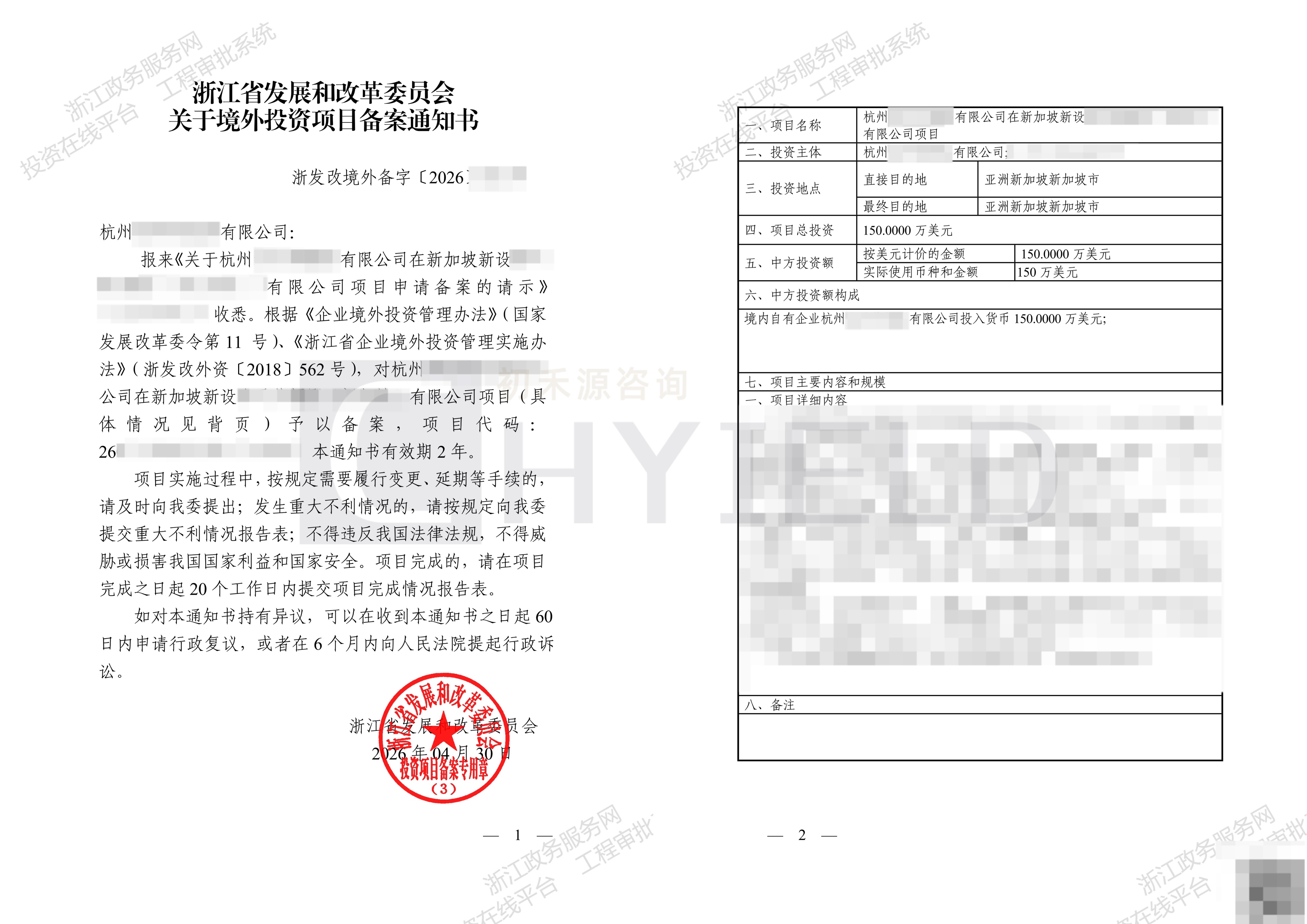
Two‑Tier Corporate Structure Project within Singapore
1. Project Background
Client: a Hangzhou industrial enterprise
Investment Model: the domestic enterprise establishes a Singapore special‑purpose vehicle (SPV), which then sets up an operating subsidiary in Singapore (forming a two‑tier structure inside Singapore)
Final Investment Destination: Singapore
Total Investment Amount: USD 1.5 million
Funding Source: domestic self‑owned capital
Project Application: leasing and renovation of local business premises in Singapore, equipment procurement, team recruitment and daily operational expenses
2. Core Difficulties
1. Justification for the same‑country two‑tier structure
Since the holding SPV and the operating entity are both registered in Singapore, it is necessary to clearly define their functional boundaries, elaborate the division of responsibilities and the necessity of adopting a two‑tier framework, and avoid being deemed duplicate incorporation or shell entities by regulators.
2. Verification of fund utilization
A detailed budget covering store rental, renovation, equipment purchase, payroll and other expenditures must be submitted to justify the deployment of the USD 1.5 million investment.
3. Rigorous review of commercial substance
For this asset‑light service project, credible evidence of actual business scenarios and profit projections is mandatory.
4. Strict requirements for capital traceability
Complete documentation proving the funding source and the full cross‑border capital flow path is required.
3. Solutions Provided by Chuheyuan
1. Pre‑project structural planning
The holding SPV is positioned exclusively as an equity management platform, while the subsidiary undertakes frontline operations. This functional split demonstrates that the intermediate SPV will not consume redundant resources, eliminating concerns over duplicate entity setup. The enterprise’s financial capacity is also verified to confirm sufficient self‑owned capital reserves.
2. Solid demonstration of commercial substance
A feasibility study report is compiled with detailed plans for offline store operation in Singapore, workforce management and market expansion. Clear profit logic and regional strategic value are outlined to validate the genuine operational nature of the project.
3. Full‑chain capital traceability arrangement
Corporate financial statements and capital reserve certificates are organized to establish a traceable closed‑loop capital flow: domestic self‑owned capital → Singapore holding SPV → Singapore operating subsidiary.
4. Standardized document drafting and dual‑authority filing
All filing documents are prepared in strict accordance with the latest review standards issued by Zhejiang Provincial Development and Reform Commission (DRC) and Zhejiang Provincial Department of Commerce. Key emphasis is placed on functional division between the two entities, itemized capital budgets and tangible commercial implementation logic. Applications are submitted to both authorities simultaneously; the team tracks review progress in real time, responds promptly to official inquiries and optimizes submitted materials iteratively.
4. Project Outcome
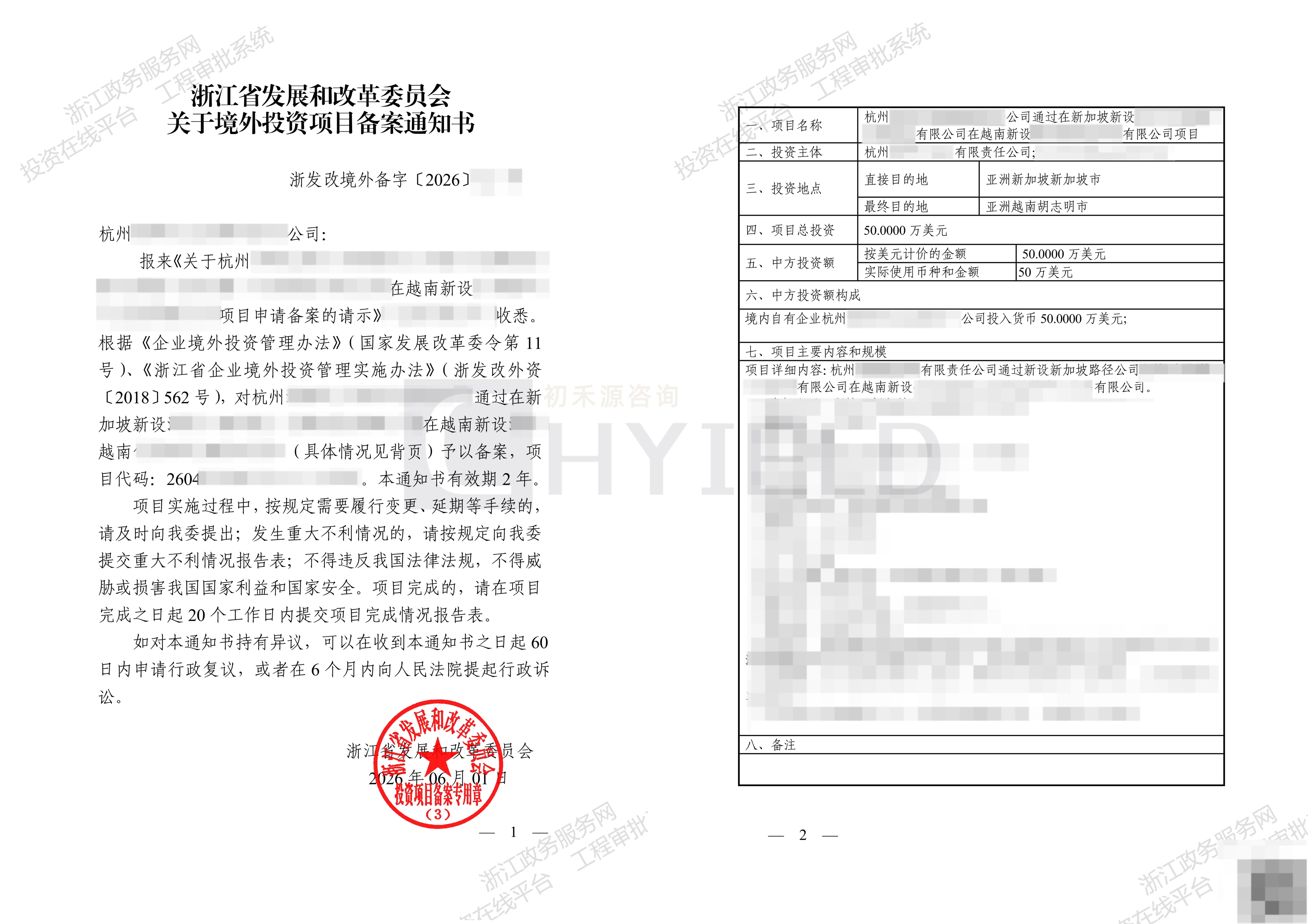
The enterprise officially obtained the Notice of Filing for Outbound Investment Projects issued by Zhejiang Provincial DRC and the Enterprise Outbound Investment Certificate issued by the Ministry of Commerce.
Case 2: A Consumer Goods Enterprise Based in Hangzhou
Cross‑Border Two‑Tier Structure Project Covering Singapore and Vietnam
1. Project Background
Client: a Hangzhou consumer goods enterprise
Investment Model: the domestic enterprise incorporates a Singapore holding SPV, which wholly owns an operational entity registered in Vietnam (cross‑border two‑tier structure)
Final Investment Destination: Vietnam
Total Investment Amount: USD 500,000
Funding Source: domestic self‑owned capital
Project Application: rental of Vietnamese office premises, team administration, brand promotion, market development and routine business operations
2. Core Difficulties
1. Compliance justification for the cross‑border two‑tier structure
Special arguments are required to prove the irreplaceable role of the Singapore platform in regional coordination across Southeast Asia, brand radiation and resource integration, and to confirm that the intermediate Singapore entity serves legitimate business purposes rather than regulatory circumvention.
2. Complete closed‑loop cross‑border business logic
Regulators require a coherent operational framework linking Singapore’s centralized holding function and Vietnam’s localized implementation. Applicants must clarify business synergy between the two overseas entities, regional layout strategies and long‑term development value.
3. Rigorous review of commercial substance
As an asset‑light project launched in Vietnam, tangible business scenarios and market expansion value need to be sufficiently evidenced.
4. Strict requirements for capital traceability
The full capital flow path of the USD 500,000 investment — from the Hangzhou parent company to the Singapore SPV and onward to the Vietnamese subsidiary — must be fully documented.
3. Solutions Provided by Chuheyuan
1. Reinforce the compliance rationale of the cross‑border structure
The team elaborates the strategic value of the Singapore SPV within the enterprise’s Southeast Asian layout, highlighting its responsibilities in brand governance, regional management and cross‑border resource integration to validate the legitimate necessity of the intermediate holding layer.
2. Construct a closed‑loop cross‑border business model
A targeted cross‑border investment feasibility report is drafted to distinguish the governance functions of the Singapore SPV from the operational functions of the Vietnamese entity. Detailed plans for inter‑entity collaboration, market expansion and revenue forecasting form a feasible cross‑border commercial framework.
3. Sort out compliant cross‑border capital pathways
Comprehensive supporting documents are compiled to record domestic capital contribution, centralized fund management in Singapore and fund utilization in Vietnam. Clear capital control mechanisms and itemized expenditure plans meet regulators’ end‑to‑end traceability requirements and ensure full compliance of cross‑border fund transfers.
4. Synchronized dual‑authority filing and implementation
All cross‑border filing documents are standardized in line with Zhejiang’s latest regulatory criteria. Applications are submitted concurrently to the provincial DRC and Department of Commerce, with continuous oversight throughout the whole review cycle.
4. Project Outcome
The ODI filing for the cross‑border two‑tier structure was approved successfully. The enterprise obtained official outbound investment qualifications and established a compliant overseas expansion channel along the route: Hangzhou → Singapore → Vietnam.