

ENCYCLOPEDIA
Part One: Which Company Type Should You Choose?
Indonesia has become a premier investment destination in Southeast Asia, offering vast market potential, progressively liberalized foreign investment policies, and well-developed industrial infrastructure. For Chinese enterprises planning to establish physical operations and expand overseas, completing company registration in full compliance with local regulations is the essential first step toward launching localized operations and ensuring ongoing regulatory adherence.
This guide provides a complete practical walkthrough covering company types, registration requirements, step-by-step procedures, required documentation, and post-registration compliance obligations.
Foreign investors establishing business operations in Indonesia generally choose between two primary legal structures:
1. Foreign-Owned Limited Liability Company (PT PMA)
PT PMA (Perseroan Terbatas Penanaman Modal Asing) is the standard legal entity for foreign investors conducting substantive business operations in Indonesia. It allows foreign individuals or corporate entities to directly hold shares, execute commercial contracts, open corporate bank accounts, hire employees, and repatriate profits. For enterprises committed to long-term presence in Indonesia, PT PMA is the only viable option.
2. Representative Office (KPPA)
A Representative Office is restricted to auxiliary activities such as market research, brand promotion, and liaison coordination. It is not permitted to engage in direct revenue-generating activities including contracting, sales, or invoicing. If your objective is primarily market exploration without an immediate commitment to establishing production facilities, a Representative Office can serve as an interim step before transitioning to PT PMA.
Important Note: For the vast majority of Chinese enterprises planning substantive operations in Indonesia, PT PMA is the direct and recommended choice.
Part Two: What Are the Requirements for Registering a PT PMA?
1. Shareholders and Directors: Minimum of two shareholders (can be individuals or corporate entities). At least one director is required. Under Indonesian company law, at least one director must hold a valid Indonesian tax identification number (NPWP).
2. Commissioners: Minimum of one commissioner. The commissioner's role is to supervise the directors and may be a Chinese national. A natural person shareholder and commissioner can be the same individual, but the director and commissioner cannot be the same person.
3. Registered Address: A valid local business address in Indonesia is required.
4. Registered Capital: Minimum total investment value of 10 billion IDR (per single location and single KBLI code). Minimum paid-up capital of 2.5 billion IDR, which cannot be withdrawn for 12 months following deposit.
5. Business Scope: A detailed business scope must be provided to match the corresponding KBLI (business activity classification code).
6. Company Name: Company name must be approved through a name reservation process. The format is PT ABC where ABC represents the desired corporate name.
7. Extended Knowledge: KBLI Code - The First Critical Step
KBLI (Indonesia's Standard Classification of Business Activities) serves as the foundational basis for company registration. Before registering, you must precisely match your primary business activities to the correct KBLI code. This code determines whether foreign investment is permitted in the relevant industry, the maximum foreign shareholding percentage allowed, whether special operating licenses are required, and the applicable regulatory oversight level and ongoing compliance obligations.
Effective 15 June 2026, all newly established companies are required to use the KBLI 2025 edition for registration. The updated version introduces over 50 new categories including artificial intelligence, carbon trading, and renewable energy, aligning with current mainstream overseas expansion sectors. Submissions using the outdated KBLI 2020 codes will face application rejection, license invalidation, and potential non-compliance penalties.
Do not arbitrarily assign codes unrelated to your actual business activities. Each KBLI code carries distinct entry conditions and licensing obligations. Selecting additional codes beyond your actual scope will increase compliance costs and regulatory exposure without legitimate operational need.
Part Three: Registration Process
Step 1: Company Name Approval
Submit three alternative company names in the format PT plus Indonesian or Latin alphabet brand name. Names must not contain religious or politically sensitive terms and must not duplicate existing registered companies. The name approval process typically takes 1 to 2 working days, and the approved name remains valid for 30 days.
Step 2: KBLI Matching and Industry Entry Verification
Based on your proposed business activities, precisely match the corresponding KBLI codes. The KBLI code determines whether foreign entry is permitted, foreign ownership caps, the type of operating licenses required, and ongoing regulatory obligations.
Step 3: Document Preparation and Signing
Legal counsel will prepare the following documents for review and signature by shareholders, directors, and commissioners:
- Draft Articles of Association (Draft AoA): review only, no signature required
- Beneficial Owner Declaration (Surat Pernyataan Penetapan Pemilik Manfaat): requires signature
- Power of Attorney (Surat Kuasa PT): requires signature
- Address Confirmation Statement (Surat Pernyataan Domisili Perseroan): requires signature
- Share Capital Subscription Statement (Surat Pernyataan Setor Saham): requires signature
Following document execution, the notary will review and issue the formal Articles of Association (Akta) and Deed of Establishment (SK).
Step 4: Ministry of Law and Human Rights Registration
The notary submits the establishment application to the Ministry of Law and Human Rights through the SABH system (Legal Entity Management System).
Step 5: OSS System NIB Application
Upon receiving Ministry of Law and Human Rights approval, an authorized service provider will assist in registering an OSS corporate account and applying for the Business Identification Number (NIB) through the OSS system (www.oss.go.id).
What is NIB?
NIB (Nomor Induk Berusaha) is the unique business identification number for enterprises in Indonesia, essentially the corporate equivalent of a national ID number. It integrates multiple core functions including basic business license, tax registration linkage, customs access, and import identification number. Without an NIB, a company cannot legally operate.
Step 6: Industry-Specific Licenses (If Applicable)
For businesses operating in restricted sectors, additional licenses from the relevant line ministries are required after obtaining the NIB. Examples include:
- Food businesses: BPOM (Indonesian Food and Drug Authority) certification
- Financial services: OJK (Financial Services Authority) license
- Tourism services: Ministry of Tourism and Creative Economy operating permit
Step 7: Tax Registration and Activation
After obtaining the NIB, the company must complete full tax registration within the statutory deadline, including Coretax system activation, appointment of a tax representative, and VAT registration. Late compliance will incur tax penalties.
Step 8: Bank Account Opening
Open a local Indonesian bank account using the complete company registration documents, and deposit the paid-up capital.
Practical Note: Many Indonesian banks require that authorized directors hold a KITAS (temporary residence permit). If your director is not physically present in Indonesia for extended periods, you should plan ahead for residency visa arrangements or consider appointing a local commissioner or director.
Part Four: Documentation Required for Company Registration
Information Collection Form
Individual Shareholders:
- Clear color scan of passport bio-data page
- Clear color scan of Chinese director's passport bio-data page
- Clear color scan of commissioner's passport bio-data page
Note: If shareholders, directors, or commissioners are Indonesian nationals, please provide copies of KTP (National ID), Kartu Keluarga (Family Card), and NPWP (Tax ID).
Corporate Shareholders:
- Clear color scan of Certificate of Incorporation (if in Chinese, provide an English translation)
- Clear color scan of Articles of Association (if in Chinese, provide an English translation)
- Clear color scan of legal representative's passport bio-data page
- Complete shareholding structure chart and clear color scan of ultimate beneficial owner's passport bio-data page
Additionally:
- Clear color scan of Chinese director's passport bio-data page
- Clear color scan of commissioner's passport bio-data page
Part Five: Post-Registration Compliance Obligations
Company registration is not the end of the journey. The following ongoing compliance requirements apply:
1. Investment Activity Report (LKPM): Submit semi-annually through the OSS system, reporting capital realization and investment progress.
2. Annual Report: Effective 1 June 2026, all limited liability companies in Indonesia (both domestic PTs and foreign-invested PT PMAs) are required to submit annual operational reports through the online system. This filing is now a mandatory statutory obligation.
3. Annual Audit: Companies meeting statutory asset or revenue thresholds are required to undergo annual audits. Companies below the thresholds are exempt from mandatory audit but must still prepare annual financial statements.
4. Annual Tax Filing: Corporate income tax returns must be filed within four months following the end of each fiscal year.
5. Monthly Tax Filings: Monthly submissions are required for VAT (PPN) and employee income tax (PPh 21), among others.
6. Foreign Employee Management: Foreign directors and employees must hold valid work permits (IMTA) and residence permits (KITAS).
Part Six: Common Pitfalls to Avoid
1. Invalid Registered Address: A genuine commercial business address within Indonesia is mandatory. Invalid or non-existent addresses will result in company revocation.
2. ODI Filing Is Not Optional: Prior to making an overseas investment, domestic Chinese enterprises must complete the Outbound Direct Investment (ODI) filing process with the National Development and Reform Commission, Ministry of Commerce, and foreign exchange authorities. This is the legal prerequisite for lawful capital outbound transfers and compliant profit repatriation.
Part Seven: Indonesia Company Registration - Case Studies
CHYIELD has extensive practical experience in Indonesia company registration, covering the full establishment process for both PT PMA foreign-invested companies and Representative Offices (KPPA). We have successfully assisted numerous Chinese enterprises in establishing their legal presence in Indonesia.
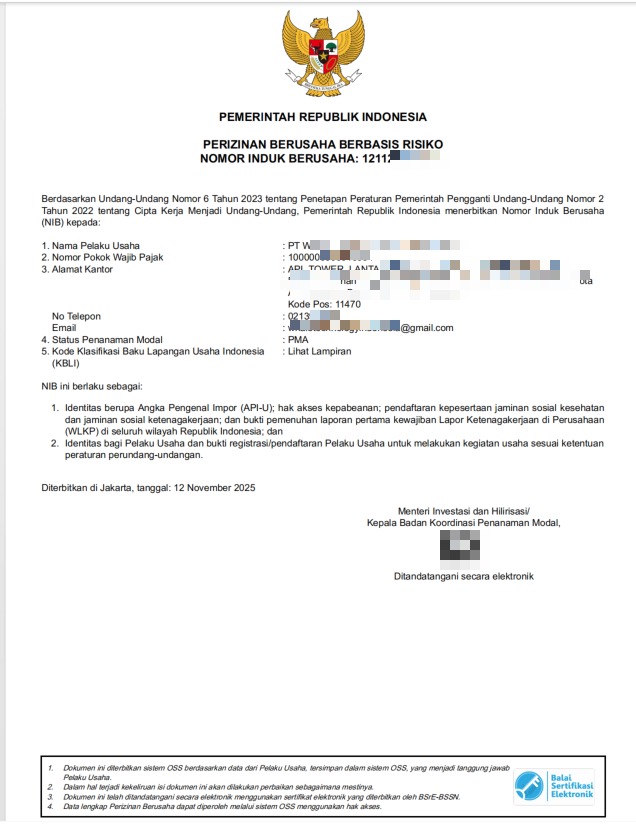
(Image placeholder: Indonesia PT PMA company registration certificate)
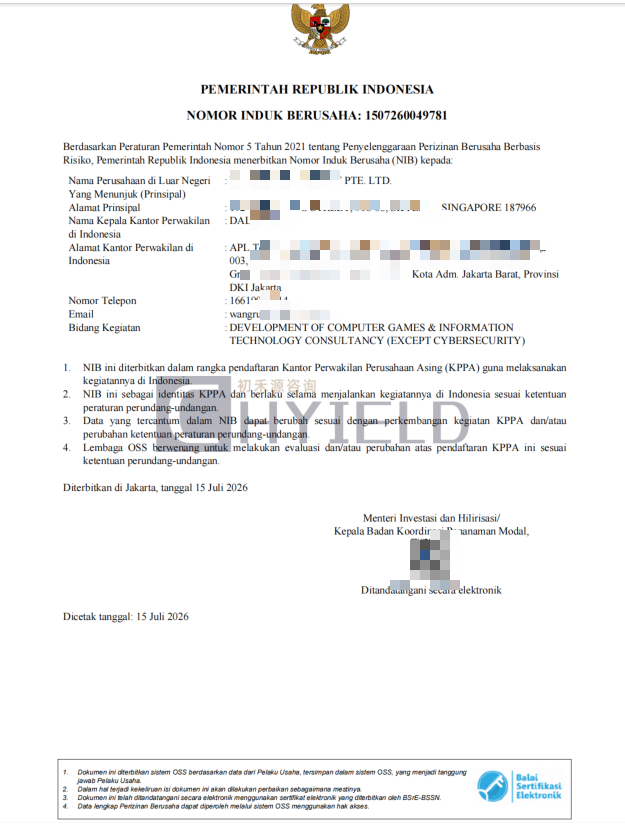
(Image placeholder: Indonesia Representative Office KPPA registration certificate)
If you have any questions regarding Indonesia company registration or are planning your establishment, please do not hesitate to contact us.
WeChat: chyieldconsulting
Website: www.chyield.com